
Completion requirements
Post-natal development refers to the physical, cognitive, emotional, and social changes that occur after birth and continue throughout a person’s life. This development is generally divided into several stages, including infancy, early childhood, middle and late childhood, adolescence, and adulthood. Each stage is characterized by distinct growth patterns and developmental milestones. In this unit, however, we will focus specifically on postnatal development from infancy through late childhood. This includes infancy, which spans from birth to two years; early childhood, from around two or three years up to six or seven years; and middle to late childhood, from seven to twelve years.
2. Early childhood (2-6 years)
2.1. Physical development in early childhood
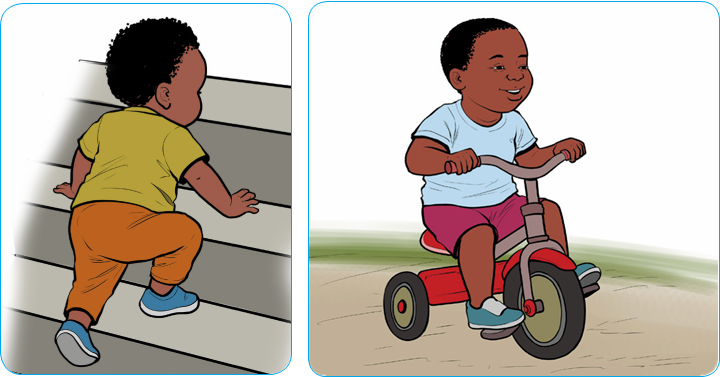
Figure: Physical Development in Early Childhood
During early childhood, the rapid physical development seen in infancy begins to slow down. Body parts grow in proportion, gradually approaching the form of a young adult by the end of this stage. Children gain approximately 2 kilograms in weight and 5 to 8 centimeters in height each year, with boys generally being taller and heavier than girls. Muscles and bones become more solid as ossification continues, and by the end of the preschool years, children begin losing their primary teeth, which are replaced by permanent ones. Brain development is also significant; by age 3, the brain reaches about 75% of its adult weight, and by age 5, it reaches around 90%.
Neurological development during this period includes hemispheric lateralisation, where the left hemisphere of the brain grows more rapidly than the right between ages 3 and 6. This can partly explain why some preschool children prefer using their left hand. Physical coordination improves as gross motor skills such as climbing, running, throwing, and catching become more refined. Fine motor skills, including tasks like cutting with scissors, develop more slowly but show steady progress. Additionally, the coordination between the left and right limbs improves significantly, enhancing the child’s ability to perform more complex movements.
Background Colour
Font Face
Font Kerning
Font Size
1
Image Visibility
Letter Spacing
0
Line Height
1.2
Link Highlight
Text Alignment
Text Colour