Section 3.2 Postnatal development
| Site: | UR - Elearning Platform |
| Course: | CD60143: Human Developmental Psychology |
| Book: | Section 3.2 Postnatal development |
| Printed by: | Guest user |
| Date: | Friday, 19 December 2025, 10:45 AM |
Description
Post-natal development refers to the physical, cognitive, emotional, and social changes that occur after birth and continue throughout a person’s life. This development is generally divided into several stages, including infancy, early childhood, middle and late childhood, adolescence, and adulthood. Each stage is characterized by distinct growth patterns and developmental milestones. In this unit, however, we will focus specifically on postnatal development from infancy through late childhood. This includes infancy, which spans from birth to two years; early childhood, from around two or three years up to six or seven years; and middle to late childhood, from seven to twelve years.
1. Infancy (0-2 years)
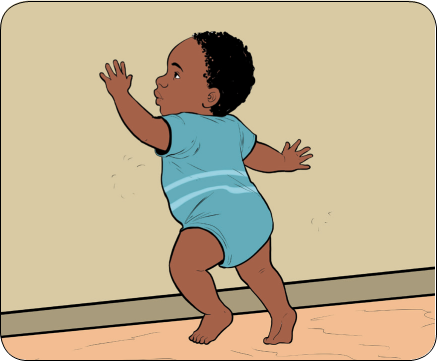
Figure: Physical Milestones during Infancy
Infancy is the earliest stage of postnatal development that spans from birth to two years of age. In this sub-section, we will look at physical and motor development during infancy, Sensory and perceptual development in infancy, cognitive development, emotional development, social as well as language development.
1.1. Physical and motor development at infancy Infancy
1.Growth in height and weight
At birth, babies weigh about 3.3 kg and are around 20 inches long. Boys are usually a little heavier than girls. In the first year, babies double their weight by 4 months and nearly triple it by their first birthday. They grow about 1 inch per month and increase length by 1.5 inches by age one.
2. Infants’ reflexes
Reflex behavioural patterns are manifested by a normal infant after birth. They are considered to be self-induced reflexes.
- Sucking reflex: This happens when newborns automatically suck anything placed in their mouth. It helps them get nourishment before they learn to connect the nipple with feeding.
- Rooting reflex: This takes place when an infant’s cheek is stroked, or the side of the mouth is touched. The infant turns the head towards the side that is touched with an attempt to suck.
- Moro reflex: This occurs when a neonate is startled and responds to a sudden intense noise or movement around it. When startled the neonate stretches its arms and legs, arches its back and throws his head sideways. All these behaviours disappear between 4th - 6th months.
- Babinski reflex: This takes place when a gentle stroke is applied on the sole of the foot whereby the neonate bends its toes and flexes the bigger toe with an effort to withdraw from the source of the stroke.
- Grasping reflex: This occurs when the neonate holds tightly onto objects placed in their palm and disappears around 4 months as they learn to grasp voluntarily.
3. Body proportions
The baby’s head grows more slowly after birth, while the body and limbs grow faster. This makes the baby less chubby and slenderer by age two.
4. Muscle and fat development
Muscles are weak and grow slowly, but fat develops quickly because milk is high in fat, helping the baby stay warm and nourished.
5. Bone development
Bones increase in number and harden over time. The soft spot on the skull (fontanel) usually closes by 1.5 to 2 years of age.
6. Teeth development
By age one, babies usually have 4 to 6 baby teeth, mainly front teeth. By age two, they have about 16 teeth, with molars appearing in early childhood.
7. Development of gross motor abilities in infancy
Gross motor skills involve the use of large muscles, like those in the arms and legs.
- In the first month, babies can lift their heads while lying on their stomach.
- By 3 months, they can lift their chest and support themselves using their arms.
- Around 3–4 months, babies can roll over.
- At 4–5 months, they can hold some weight on their legs.
- By 6 months, babies can sit without help and reach for objects easily.
- Between 7–8 months, they can crawl and stand without support.
- At 8 months, they can pull themselves up to a standing position.
- By 10–11 months, babies can walk by holding onto furniture or walls.
- By 12–13 months, most babies can walk without help.
- Between 13–18 months, toddlers can pull toys on a string
- At 10 - 11 months, infants can walk with support of furniture or by touching a wall.
- At 12 - 13 months most infants walk without assistance.
- By 13 - 18 months, toddlers pull toys attached to a string.
- By 18 - 20 months, toddlers walk or run for a short distance, walk backward without losing direction, stand and kick a ball or throw a stone or jump without falling.
- In the 2nd year, infants are capable of exploring their surrounding extensively.
8. Development of fine motor abilities in infancy:
By age 2, infants begin to use their arms, hands, and fingers more skillfully. Coordination of hands and eyes improves significantly, helping them perform more precise actions grasping.
1.2. Sensory and perceptual development in infancy
Visual Perception
- By 3 months, babies can see clearly and notice colors.
- They show interest by staring at things.
- By 5 months, they can see shapes and facial features.
- By 6 months, they can recognize familiar faces like their mother’s and tell them apart from strangers or objects.
Hearing
- Between 8 and 28 weeks, babies can tell where sounds are coming from.
- They move their eyes or heads toward the sound.
- Smell
- Newborns can tell the difference between good and bad smells.
- Pleasant smells (like vanilla) make them happy, while strong or unpleasant smells (like alcohol or petrol) cause fast heartbeat or breathing.
Taste
- Babies can taste from birth.
- They prefer sweet tastes and suck more when milk is sweetened.
- They show dislike by pursing lips when given sour, bitter, or salty tastes.
Touch and pain
- Newborns respond strongly to touch, especially on sensitive areas like the feet, palms, ears, and eyes.
- They can connect what they feel with what they see.
- Babies feel pain, as shown by crying during procedures like circumcision, even at just a few days.
1.3. Cognitive development in infancy
Cognitive development during the infancy period corresponds to the sensorimotor stage in Piaget’s cognitive theory. During this stage, development is based on the information babies gain through their senses and body movements. There are six phases of cognitive development at the sensorimotor stage.
- Sub stage 1: Reflexive activities (birth to 1 month): Those are automatic responses to particular stimuli. Examples: Blinking, Grasping, Rooting, and Sucking. Babies don’t yet understand that they are separate from the world around them. No play, no imitation, and no idea that objects still exist when out of sight.
- Sub stage 2: Primary circular reactions (1–4 months): Infants primarily engage in behaviors that center around their own bodies, often repeating these actions multiple times. This repetitive focus is essential for their motor skill development and sensory exploration. Example: An infant might now open and close her hand and then put it in her mouth. Imitation starts, but it’s limited.
- Sub stage 3: Secondary circular reactions (4–8 months): Infants become more aware of and more responsive to the outside world (their behaviors become secondary), and they begin to notice that their behaviors can have interesting effects on the objects around them. Babies focus on things outside their body and repeat actions that produce fun results (e.g., banging a spoon). They begin to imitate others and can search for partly hidden objects—early signs of object permanence. Example: a child of this sub-stage will continue to play with a spoon on a plate since it produces an enjoyable noise.
- Sub stage 4: Coordination of secondary circular reactions (8–12 months): Infants gradually acquire knowledge of cause-effect relationships. Accordingly, they begin to engage in goal- directed behavior: They behave in ways that they know will bring about desired results. This is their first true problem-solving behavior. They also begin to combine behaviors in new ways to accomplish their goals. They show intentional and planned actions.
- Sub stage 5: Tertiary circular reactions (12-18 months): The circular reactions become experimental and creative. The infant repeats an action with variation aiming to provoke new outcomes. Babies experiment with different actions to see new results (e.g., trying different ways to get a toy). They explore objects more deeply and search for hidden items in different places. They begin to imitate new behaviors they haven’t seen before. Example: Observed the relationship between a mate and a toy, the child will pull the mate so that he /she can take the toy.
- Sub stage 6: Mental representation (18 months to 2 years): It involves the ability to make a mental representation, that is the internal images of absent objects and past events. Babies understand that objects exist even when out of sight (full object permanence). They can now picture things in their mind (e.g., remember where a toy was). They can imitate actions they saw earlier, even if the person is no longer there (deferred imitation). Example: when a caregiver hides an attractive toy beneath a pillow, the infant knows that the toy still exists, also knows where it exists, and will attempt to retrieve it (Rwanda Education Board, 2020).
1.4. Language development in infancy
Language learning is one of the most important and exciting parts of a child’s early development. Babies begin to communicate from birth, and they can understand language even before they are able to speak. During infancy, language development is divided into two main periods.
1.Prelinguistic Period (birth to 12 months)
- Undifferentiated crying (0–1 month): Babies cry to express needs, but the cries sound the same.
- Differentiated crying (from 2 months): Parents start recognizing different cries for hunger, pain, or discomfort.
- Cooing and happy sounds (by 3 months): Babies make various sounds when they are content and begin repeating these sounds (called the “bird stage”).
- Babbling (around 5 months): Babies repeat sounds like “da-da” or “ma-ma.”
- Lallation (7–10 months): Babies repeat sounds they hear. At first, it happens by accident, then more purposefully and correctly.
- Single-Word Sentences (around 1 year): Babies start using one word to express full ideas. For example, saying “milk” to mean “I want milk.”
2. Linguistic Period (1–2 years)
- Holophrastic stage (12–18 months): Children use one word and gestures or tone to express a full message.
- By 18 months: They start putting words together in simple ways, using short phrases like “mom gone” to mean “Where is mom?” (called telegraphic speech).
- By 2 years: Most children can say around 300 words and begin forming basic sentences.
1.5. Emotional development at infancy
- Babies show basic emotions such as happiness, anger, sadness, and fear, mostly through their facial expressions.
- Smiling begins early by the first month, babies smile at interesting things.
- Between 6 and 10 weeks, they develop a social smile when seeing human faces.
- By 3 months, they smile at anyone, especially familiar people.
- Laughing starts around 4 months, often when being kissed or tickled.
- Fear of strangers starts around 6 months and becomes stronger by 8months this is called 8th month anxiety.
- Crying is a way babies express their needs and show they want control.
- From birth to 6 months, babies show more happiness, especially around familiar people.
- Between 7–12 months, fear and anger increase, and they look to caregivers as a safe base.
- From 1 to 2 years, emotions like shame, pride, guilt, and embarrassment begin to appear, but only when others are present.
1.6. Social development in infancy
• Social development begins with the care infants receive, especially from their mothers. These early interactions help form attachment, which is a strong emotional bond between the baby and the people who care for them.
• Attachment makes babies feel happy and safe when around familiar people and helps build trust and closeness.
1.7. Attachment development during infancy period
- Pre-attachment (0–2/3 months): Babies smile at anyone and can be comforted by anyone.
- Focusing on familiar people (3–6 months): Babies start to smile more and react positively to caregivers they know well.
- Clear-cut attachment (6–12 months): Babies form strong bonds with caregivers. They cry or protest when the caregiver leaves. They also start attaching to other family members.
- Reciprocal relationships (from 2 years): Children begin to understand that their actions affect others. For example, they may cry to get what they want or ask for explanations when parents leave.
2. Early childhood (2-6 years)
Early childhood is the period that follows infancy, typically spanning from about two to six years of age. It is a vital stage of rapid growth and development in which children become more independent, improve their motor and language skills, and begin to form social relationships outside the family. During this time, curiosity, imagination, and play play a central role in learning, laying the foundation for later academic and emotional development.
The following are characteristics of early childhood period.
2.1. Physical development in early childhood
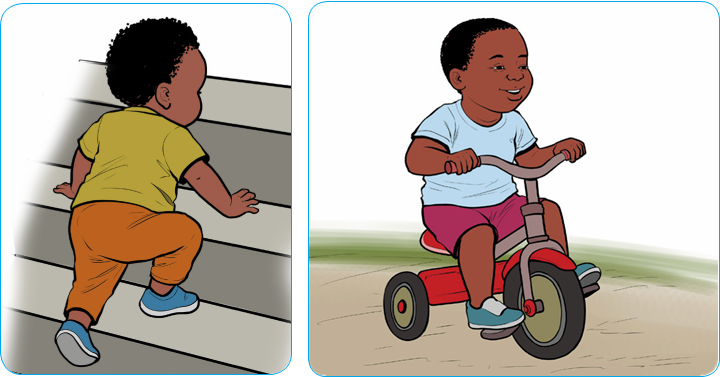
Figure: Physical Development in Early Childhood
During early childhood, the rapid physical development seen in infancy begins to slow down. Body parts grow in proportion, gradually approaching the form of a young adult by the end of this stage. Children gain approximately 2 kilograms in weight and 5 to 8 centimeters in height each year, with boys generally being taller and heavier than girls. Muscles and bones become more solid as ossification continues, and by the end of the preschool years, children begin losing their primary teeth, which are replaced by permanent ones. Brain development is also significant; by age 3, the brain reaches about 75% of its adult weight, and by age 5, it reaches around 90%.
Neurological development during this period includes hemispheric lateralisation, where the left hemisphere of the brain grows more rapidly than the right between ages 3 and 6. This can partly explain why some preschool children prefer using their left hand. Physical coordination improves as gross motor skills such as climbing, running, throwing, and catching become more refined. Fine motor skills, including tasks like cutting with scissors, develop more slowly but show steady progress. Additionally, the coordination between the left and right limbs improves significantly, enhancing the child’s ability to perform more complex movements.
2.2. Cognitive development in early childhood
Cognitive development during early childhood aligns with Piaget’s preoperational stage, which spans from approximately 2 to 7 years of age. At this stage, children begin to think symbolically, meaning they can use their imagination, recognize and use symbols (like pretending a stick is a sword), and understand that objects continue to exist even when they are out of sight. These abilities mark significant progress from the sensorimotor stage of infancy.
However, children’s thinking during this stage is still egocentric, i.e. they find it difficult to see situations from perspectives other than their own. They also lack the ability to think logically or carry out mental operations, such as mentally adding or comparing quantities. One key concept they have not yet grasped is conservation the understanding that quantity remains the same even when its appearance changes, such as when water is poured into a glass of a different shape.
Children can mentally represent objects that are not present (e.g., thinking about a toy that’s not in the room). Two key features:
• Egocentrism: Children believe everyone sees the world the same way they do.
• Animism: They believe non-living things (like toys or the sun) have feelings or human qualities.
Children begin to use basic reasoning and often ask many questions like “why?” or “how?” They believe they are right, even if they can’t explain why. Two common thinking errors:
• Centration: They focus on one aspect of something and ignore others (e.g., thinking a taller glass has more water even if it’s the same amount).
• Lack of conservation: They don’t yet understand that quantity doesn’t change when the shape or arrangement changes.
2.3. Language development in early childhood
Language development improves significantly during early childhood (ages 2–6). During this period, children go through major growth in both understanding and using language. Receptive language (understanding what others say) and productive language (speaking and expressing ideas) develop rapidly. Children at this stage can follow more complex instructions and express their own needs, thoughts, and feelings more clearly.
On average, children learn about nine new words every day. By the time they are six years old, their vocabulary typically grows to between 10,000 and 13,000 words. This fast word learning is often called a “vocabulary explosion.” As they grow older, children continue to expand their vocabulary and improve their grammar through interaction with parents, older siblings, and others around them.
2.4. Socio-emotional and moral development in early childhood
During early childhood, children begin to develop a clearer sense of self, known as self-concept. This includes awareness of themselves as individuals, the development of self-esteem, and understanding their gender identity whether they are a boy or a girl. Around the age of 3, many children experience a personality or opposition crisis, during which they assert independence by frequently saying “no.” This behavior is not a sign of defiance, but rather a developmental step in learning autonomy, supported by their growing physical and language abilities.
Children at this stage also express emotions openly. Joy and excitement are shown through laughter, jumping, or clapping, while more complex emotions like shame, embarrassment, and guilt which begin to emerge around 18 months continue to mature. At the same time, children start developing empathy, or the ability to understand and respond to the emotions of others, although this skill is still in its early stages.
In terms of moral development, young children have a very basic understanding of right and wrong, often relying on what adults tell them. Around the age of 5, they enter the stage of heteronomous morality, where they believe rules are fixed by adults and must be followed exactly. They also tend to believe in imminent justice, the idea that breaking rules always leads to punishment. At this stage, they assume that everyone shares the same understanding of rules and morality as they do.
3. Middle and late childhood (6-12 years)
Middle and late adulthood are described in the following pages.
3.1. Physical development in middle and late childhood
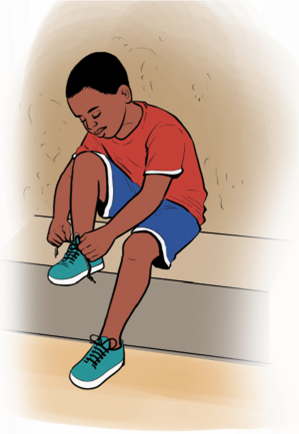
Figure: Physical Milestones during Middle and Late Childhood
During the school-age years, typically between the ages of 6 and 12, children experience steady and continuous physical growth. Unlike the rapid changes seen in infancy and toddlerhood, this stage is marked by moderate but consistent increases in height and weight. A noticeable aspect of this growth is that the arms and legs grow more rapidly than the rest of the body, making children appear taller and more proportionate compared to their earlier years. This gradual growth pattern serves as a foundation for the more dramatic changes that occur later during puberty.
Alongside these physical changes, children also develop stronger muscles and improved coordination, which enhances their ability to perform physical tasks. They become more skilled at activities such as running, jumping, and throwing, and their balance, agility, and motor control allow them to participate more effectively in sports, games, and other physical exercises. This period is essential for developing physical fitness, body confidence, and refining gross motor skills. Additionally, children begin to lose their primary teeth around age 6, which are gradually replaced by permanent adult teeth, marking another key milestone in physical development.
3.2. Cognitive development in middle childhood
During the school-age years, children’s thinking becomes more logical and organized, especially when dealing with real or concrete information. Although they are not yet able to reason abstractly, they show significant progress in understanding and processing tangible facts and experiences. One key development is the improvement of classification skills. Children in this stage can sort and group objects based on multiple features such as shape, size, and color simultaneously. By around age 12, most children are capable of classifying items using two or three characteristics at once, demonstrating a more advanced and flexible way of thinking.
During the school-age years, children develop an understanding of conservation, meaning they realize that an amount remains the same even if its shape or appearance changes, as long as nothing is added or taken away. This cognitive milestone reflects their growing ability to apply logical thinking to concrete situations. Their understanding deepens over time, with conservation of substance and mass typically grasped by around age 10, and conservation of volume understood by about age 11 or 12.
Children use logical arguments to explain conservation:
• Compensation: “This container is taller but thinner, so it still holds the same.”
• Identity: “Nothing was added or taken away, so it’s still the same amount.”
• Reversibility: “If I pour the water back, it will look just like before.”
• Concrete thinking: At this stage, children can only apply logic to things they can see or touch (concrete objects). As they get older, they slowly start to understand abstract ideas (which are part of the next stage — formal operations).
3.3. Moral development in middle childhood
• Understanding rules and consequences: Children learn that rules are important and that actions have results. They begin to follow rules more willingly, not just to avoid punishment but because they understand why the rules exist.
• Developing empathy: Children start to care more about how others feel. They can put themselves in someone else’s shoes and feel sorry if someone is hurt.
• Better moral thinking: They don’t just think, “What happens if I get caught?” but start thinking about why something is right or wrong. They consider people’s intentions and what is fair.
• Learning right from wrong: Children begin to understand that some rules (like being kind or telling the truth) are more important than others (like classroom routines). They start to see moral rules as what’s truly right.
• Influence of friends: Friends become important. Children watch what others do and learn by talking and playing together. They practice being fair, honest, and kind during games and group work.
• Moral identity and feelings: Children start to think about what kind of person they want to be. If they do something wrong, they may feel guilty or ashamed because they know it doesn’t match their values.
3.4. Language development in middle childhood
- Vocabulary grows dramatically; children understand and use more complex sentences and academic language.
- They refine grammar, punctuation, and spelling, and can write organized paragraphs and short essays.
- Reading fluency increases, and comprehension skills deepen.
- Children use language not just for communication, but also for learning, debating, and expressing opinions.
- Exposure to books, discussions, and school subjects enhances language
Background Colour
Font Face
Font Kerning
Font Size
Image Visibility
Letter Spacing
Line Height
Link Highlight
Text Alignment
Text Colour