
Section outline
-
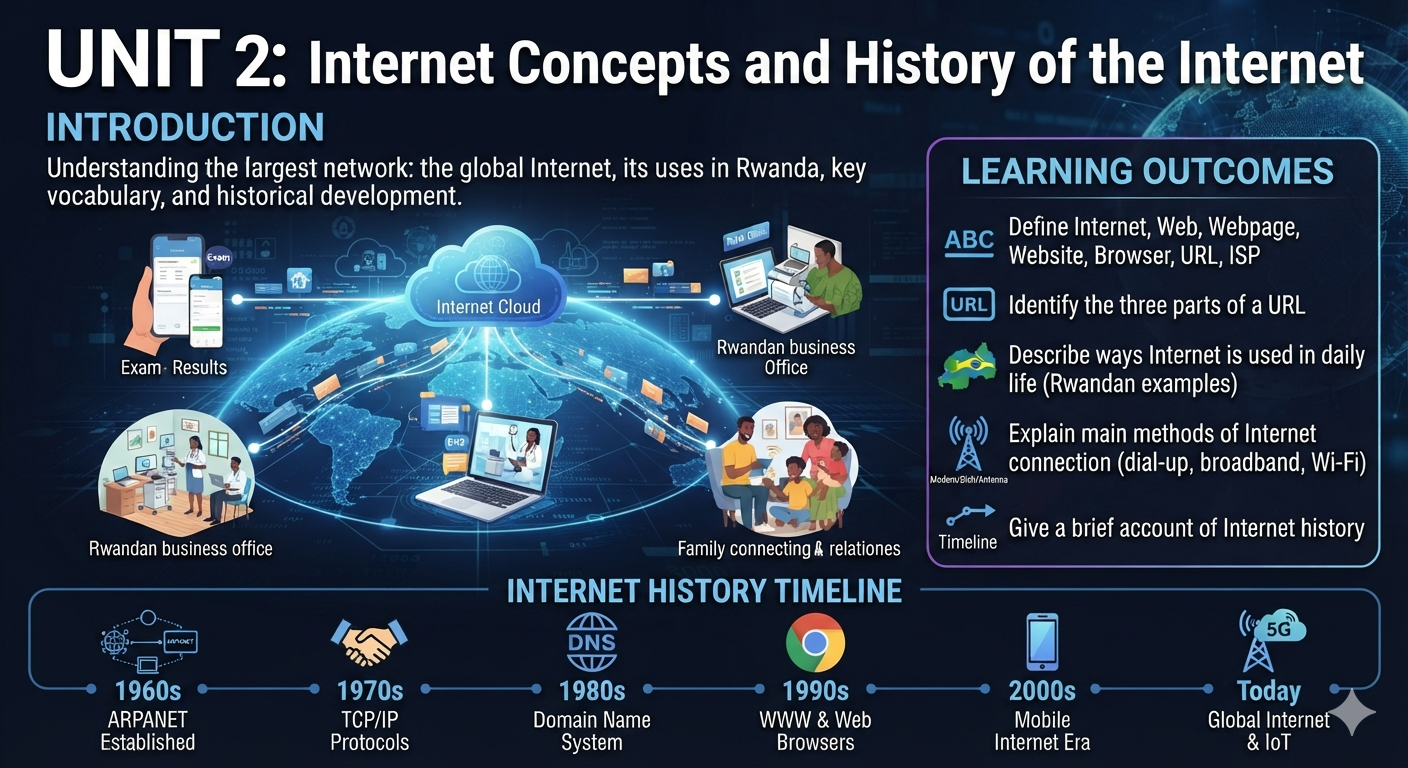
Introduction
If Unit 1 was about how devices connect to each other, this unit is about the largest network of all: the Internet, a worldwide network of networks that touches nearly every part of daily life in Rwanda and beyond — from checking exam results online to running a business, staying in touch with family, or consulting a doctor remotely. This unit explains the key vocabulary you need to talk about the Internet confidently, shows you how to read a web address, and tells the story of how the Internet came to exist and grow into what it is today.
Learning Outcomes
By the end of this unit, you should be able to:
1. Define the Internet, the World Wide Web, a webpage, a website, a web browser, a URL, and an ISP.
2. Identify the three parts of a URL and explain what each part tells you.
3. Describe at least three ways the Internet is used in daily life, with a Rwandan example for each.
4. Explain the main methods of connecting to the Internet (dial-up, broadband, Wi-Fi).
5. Give a brief, accurate account of how the Internet developed historically.-
Interactive UNIT 2: internet concepts and history for Rwandan Students Reading Notes
-