Section 3.3 Adolescence
| Site: | UR - Elearning Platform |
| Course: | CD60143: Human Developmental Psychology |
| Book: | Section 3.3 Adolescence |
| Printed by: | Guest user |
| Date: | Friday, 19 December 2025, 7:17 AM |
Description
The term adolescence is derived from the Latin word “adolescence’ that means to grow to adulthood. Adolescence begins as a separate developmental stage at about the age 11 and ends at about the age of 22, the adolescence developmental stage can be distinguished based on physical and psychological characteristics and social roles. Adolescence is considered the transitional stage from childhood to adulthood that occurs between ages 13 and 19 (Santrock, 2018). But the physical and psychological changes that take place in adolescence can start earlier, during the preteen years between ages 9 and 12. Stanley Hall (1844-1924) is known as the father of adolescent psychology. He constructed a psychological theory of teenage development, and one major aspect of his theory was that this stage of life is characterized by ‘storm and stress” that most teens are by nature moody and untrustworthy.
The many physical, sexual, cognitive, social, and emotional changes that happen during this time can bring anticipation and anxiety for both adolescence and their families. Understanding what to expect at different stages can promote healthy development throughout adolescence and into early adulthood.
1. Physical development
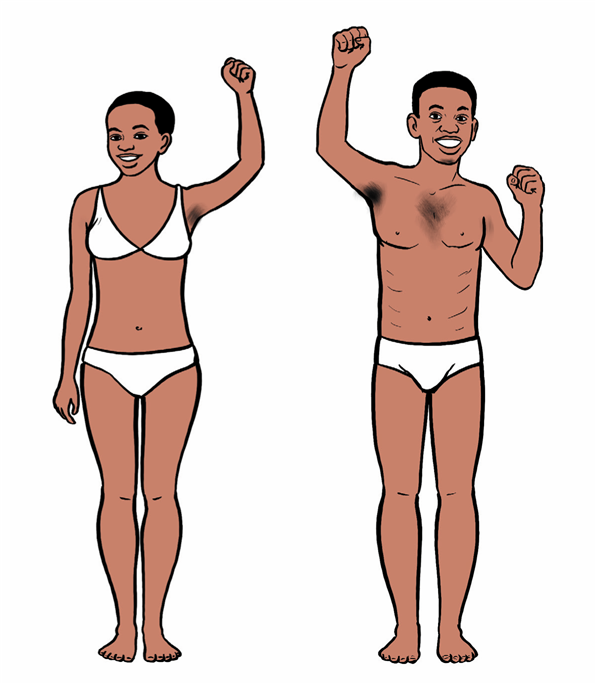
Figure: Adolescents’ Changes
Adolescence starts with puberty, which marks the beginning of significant physical changes. Although the order of these changes is generally consistent, the age at which they begin, and their rate of progression differ widely among individuals. Key developments during puberty include adrenarche and gonadarche, which refer to the maturation of the adrenal glands and the sex glands, respectively. During this stage, both primary and secondary sexual characteristics begin to develop. Primary characteristics involve reproductive organs such as the ovaries and uterus in girls and the testes in boys while secondary characteristics refer to outward physical signs like breast development and wider hips in girls, facial hair growth and deeper voices in boys (Steinberg, 2016).
Girls typically experience menarche the onset of menstruation around the ages of 12 or 13, while boys undergo spermarche, or their first ejaculation, usually between 13 and 14. Both boys and girls go through a rapid growth phase known as a growth spurt. For girls, this usually starts between ages 8 and 13, with adult height reached between 10 and 16. Boys start a bit later, around 10 to 16 years, and usually reach their adult height between 13 and 17. Both genetic factors (nature) and environmental influences (nurture), such as nutrition, medication, or medical conditions, can affect physical growth.
Because the pace of physical development can differ so much among adolescents, puberty often becomes a source of either pride or insecurity. Boys who mature early are generally taller, stronger, and more physically capable than their peers, often gaining social advantages like increased popularity and confidence. However, they may also be more prone to risky behaviors, including substance use and early sexual activity. Girls who mature early might attract attention both negative and positive that makes them feel awkward or self-aware about their changing bodies. This group is more susceptible to mental health issues such as depression, substance use, and eating disorders. On the other hand, teens who mature later than their peers, both boys and girls, may struggle with low self-esteem due to their delayed physical development. This is especially challenging for late-developing boys, who are at a higher risk for depression, parent-child conflicts, and bullying.
1.1. Adolescence growth spurt
During adolescence, the rate of increase in height and weight is accelerated. Depending on feeding and other factors, girls attain their adult height towards late adolescence while boys reach their adult height during their early twenties. The speed of growth is different for various parts though all the body parts grow rapidly. This disproportionate growth rate of different body parts is referred to as asynchrony.
1.2. Psychological effect of physical changes
Irrespective of being an early or late maturer, a youngster will often experience social and psychological consequences of the physical changes on his or her body. During the adolescence period, adolescents are acutely aware of the physical changes they experience; for instance, they believe that everyone watches them and that their bodies constantly betray them.
Girls worry about menarche, and it is a negative experience especially when it begins at a very early age. They experience a high level of depression, especially those who had not been prepared for menstruation. On the other hand, girls who are prepared for this event usually accept it as a sign of femininity.
The physical changes also result in an increase in social maturity. Boys get concerned very much with the uncontrolled erection of the penis and ejaculation. Although most boys are proud of this ability and see it as a sign of virility, the inability to control erection leads to embarrassment. Nocturnal emissions also make some boys feel humiliated and guilty. Uncontrolled erections make some boys afraid of participating in activities (dancing).
2. Cognitive development
Adolescents are found in the formal operational stage of cognitive development. They can understand and deal with hypothetical tasks. This is because they can pay attention and remember. During adolescence, teenagers move beyond concrete thinking and become capable of abstract thought. Recall that Piaget refers to this stage as formal operational thought. Teen thinking is also characterized by the ability to consider multiple points of view, imagine hypothetical situations, debate ideas and opinions (e.g., politics, religion, and justice), and form new ideas, Adolescents can deal with abstract concepts, They are capable of hypothetical deductive reasoning (reasoning from possible to real)
They have a good understanding of moral concepts, that is they can differentiate between what is good and what is bad or undesirable for society, they can reason scientifically: they are able to see the relationship between theory and evidence.
Cognitive empathy begins to increase in adolescence and is an important component of social problem solving and conflict avoidance. According to one longitudinal study, levels of cognitive empathy begin rising in girls around 13 years old, and around 15 years old in boys (Van der Graaff et al., 2013). Teens who reported having supportive fathers with whom they could discuss their worries were found to be better able to take the perspective of others. They can communicate with others and make decisions, they have increased their ability to understand, see relationships and solve problems of increased complexity.
2.1. Adolescents ‘egocentrism’
The tendency to be thoroughly embedded in their newfound ideas, concepts and principles without considering the views of significant others) is characterized by the following problems: argumentativeness, indecisiveness, self-centered, finding fault with authority, self-consciousness (Steinberg, 2019).
i. Argumentativeness. Adolescents have a tendency of regarding their views and principles as the best and most accurate. Parents and teachers should therefore take part in discussing with adolescents new issues they discover and how they (adolescents) should react to them.
ii. Indecisiveness. Adolescents face a problem of deciding on things. This is because they have a great deal of choices in every aspect of life. They continuously discover and experience new things in their lives.
iii. Self-Centred. Adolescents have a particular perception of themselves. They think that they are special, unique and not subjected to natural rules that govern the world. For instance, a girl may think that she cannot get pregnant or a boy may think that he is wise enough and cannot get addicted to smoking or cannot make a girl pregnant, they think that these things only happen to other people but not to them. This kind of thinking and reasoning make them fearlessly indulge in many risky ventures. Therefore, they need to develop a realistic awareness of the ways in which they are not exempted from the natural or societal order of things.
iv. Finding Fault with Authority. Since adolescents now have the ability to imagine an ideal world, they realise that people they have honoured and given esteem to are not as perfect as they thought.
v. Self-Consciousness. Adolescents have the mentality that others constantly watch and make comments about them. Adults should therefore avoid making public criticism or ridicule. During adolescence, many adolescents are more concerned with their body image.
2.2. Socio-emotional development
Adolescence is a critical stage marked by profound emotional and social changes. While adolescents may experience similar emotions, the intensity, triggers, and ways of responding to those emotions differ significantly. These differences are largely influenced by the hormonal and physical changes that occur during puberty, which often make adolescents more emotionally reactive and sensitive. Their moods may shift rapidly, and emotional responses can appear exaggerated or inconsistent.
Adolescents and young children experience similar emotions, but they are different in intensity, reaction and stimuli that lead to those emotions. The physical changes at puberty have effects on the adolescent’s emotions. They normally change so quickly in them emotional manifestations.
According to Freud’s psychoanalytic theory, adolescence is the genital stage where sexual maturity is reached, and the focus turns to forming intimate relationships. Emotional and physical changes during puberty shape adolescents’ self-image and influence how they interact socially. They begin to seek deeper connections beyond the family, especially romantic ones. Internal conflicts may arise between desires, reality, and moral standards, affecting emotional stability. Successfully resolving these tensions helps adolescents develop emotionally mature and socially responsible relationships. However, unresolved issues from earlier stages may resurface and hinder healthy development. Social experiences during this time are crucial for shaping adult identity and emotional growth. Physical changes affect self-image and emotional responses, influencing social interactions and identity formation.
2.3. Moral development
Adolescents develop more complex moral reasoning, moving beyond simple rules to consider intentions, social contracts, and universal ethical principles (Kohlberg’s conventional stage). Erikson’s psychosocial theory places adolescence in the stage of identity vs. role confusion, where moral values and personal beliefs are explored and solidified. Adolescents may challenge family and societal norms as they develop their own ethical framework.
2.4. Attachment and social development
Emotional bonds expand beyond family to include close friendships and romantic relationships. Attachment during adolescence shifts toward peers and significant others, forming the basis for adult intimacy, The appearance of adult physical characteristics brings new demands from parents for the adolescent to be more responsible and to act more like an adult. In this transition, the adolescent-parent relationship tends to deteriorate, and the home ceases to be the centre of social and emotional interest. As a result, adolescents develop more relationships with people outside the family, Healthy attachment and social support are crucial for emotional well-being and identity development.
2.5. Language development
Language becomes more sophisticated, with increased use of abstract vocabulary and complex sentence structures. Adolescents use language to express identity, argue viewpoints, negotiate social situations, and explore abstract concepts. Communication skills improve in both oral and written forms, supporting academic success and social relationships.
Background Colour
Font Face
Font Kerning
Font Size
Image Visibility
Letter Spacing
Line Height
Link Highlight
Text Alignment
Text Colour