Section 2.6 Moral development theory
| Site: | UR - Elearning Platform |
| Course: | CD60143: Human Developmental Psychology |
| Book: | Section 2.6 Moral development theory |
| Printed by: | Guest user |
| Date: | Friday, 19 December 2025, 8:55 AM |
Description
Based on Piaget’s theory of cognitive development, American psychologist Lawrence Kohlberg (1927-1987) developed his own theory of moral development in children. Kohlberg believed that people progressed in their moral reasoning (i.e., in their bases for ethical behavior) through a series of stages. According to Kohlberg’s theory of moral development, there are 6 stages of moral development, known as Kohlberg’s stages of moral development. Kohlberg classified their moral reasoning into three levels, each of which contains two distinct substages.
1. Kohlberg’s Three levels of moral development
Levels and stages of moral development are described in the paragraphs below.
1.1. Level 1: Pre-conventional morality
Focus: Decisions are based primarily on self-interest and avoiding punishment. At the pre-conventional level (most nine years old and younger, some over nine), we don’t have a personal code of morality. Instead, our moral code is shaped by the standards of adults and the consequences of following or breaking their rules. Authority is outside the individual and reasoning is based on the physical consequences of actions
Stage 1: Obedience and punishment orientation. The child/individual is good to avoid being punished. If a person is punished, they must have done wrong.
Stage 2: Individualism and exchange. At this stage, children recognize that there is not just one right view that is handed down by the authorities. Different individuals have different viewpoints.
1.2. Level 2: Conventional morality
Focus: Decisions are guided by social expectations, relationships, laws, and societal order. At the conventional level (most adolescents and adults), we begin to internalize the moral standards of valued adult role models. Authority is internalized but not questioned, and reasoning is based on the norms of the group to which the person belongs.
Stage 3: Good interpersonal relationships. The child/individual is good to be seen as being a good person by others. Therefore, answers relate to the approval of others.
Stage 4: Maintaining the social order. The child/individual becomes aware of the wider rules of society, so judgments concern obeying the rules to uphold the law and to avoid guilt.
1.3. Level 3: Post-Conventional Morality
Focus: Decisions guided by higher ethical principles and individual rights beyond societal laws. Individual judgment is based on self-chosen principles, and moral reasoning is based on individual rights and justice. According to Kohlberg this level of moral reasoning is as far as most people get.
Stage 5: Social contract and individual rights. The child/individual becomes aware that while rules/laws might exist for the good of the greatest number, there are times when they will work against the interest of particular individuals. The issues are not always clear-cut.
Stage 6: Universal principles. People at this stage have developed their own set of moral guidelines which may or may not fit the law. The principles apply to everyone. E.g., human rights, justice, and equality.
NB: The person will be prepared to act to defend these principles even if it means going against the rest of society in the process and having to pay for the consequences of disapproval and or imprisonment. Kohlberg doubted few people reached this stage.
2. Illustration of the stages of moral development
The levels and stages are illustrated in the following figure:
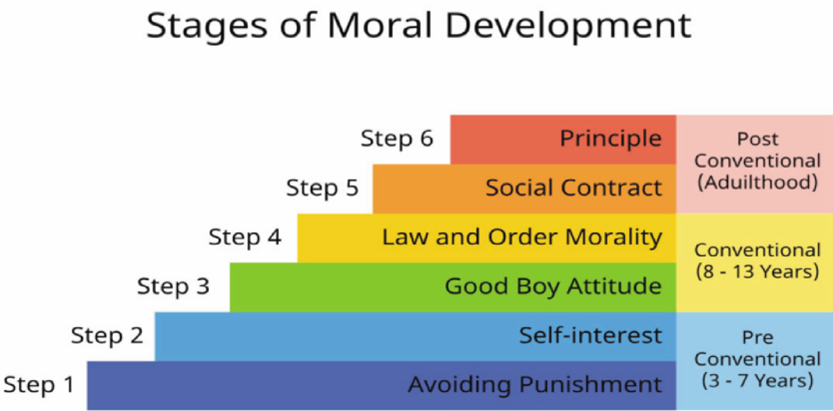
Figure: Stages of moral development
Source: McLeod (2024, p. 10)
3. A real life classroom example of moral development theory
An example is a student who witnesses cheating on an important exam. The student is faced with the dilemma of whether to report the cheating or keep quiet.
• A person at the pre-conventional level of moral development might choose not to report cheating because they fear the consequences or because they believe that everyone cheats.
• A person at the conventional level might report cheating because they believe it is their duty to uphold the rules and maintain fairness in the academic environment.
• A person at the post-conventional level might weigh the ethical implications of both options and make a decision based on their principles and values, such as honesty, fairness, and integrity, even if it may come with negative consequences.
This example demonstrates how moral development theory can help us understand how individuals reason about ethical dilemmas and make decisions based on their moral reasoning.
4. Educational implications of moral development theories
• Teachers can present age-appropriate moral dilemmas and guide students to discuss different viewpoints. This encourages critical thinking and helps students progress in moral reasoning.
• Group activities that require sharing, fairness, and collaboration foster empathy and respect, reinforcing moral values through peer interaction.
• Teachers should demonstrate fairness, honesty, and respect in their actions, as students learn moral behavior by observing adults.
• By understanding students’ stages of moral development (as described by Kohlberg), teachers can set realistic behavioral goals and use appropriate discipline strategies.
• Subjects like literature, history, and social studies can be used to explore themes of justice, responsibility, and human rights, making moral development part of everyday learning.
• A classroom culture that values diversity, respect, and open dialogue promotes moral and ethical growth among students.
Background Colour
Font Face
Font Kerning
Font Size
Image Visibility
Letter Spacing
Line Height
Link Highlight
Text Alignment
Text Colour