Section 2.5 Attachment theories
| Site: | UR - Elearning Platform |
| Course: | CD60143: Human Developmental Psychology |
| Book: | Section 2.5 Attachment theories |
| Printed by: | Guest user |
| Date: | Friday, 19 December 2025, 7:14 AM |
Description
Attachment theory, developed by John Bowlby and later expanded by Mary Ainsworth, explores the deep emotional bonds that form between children and their primary caregivers. It emphasizes that early interactions with caregivers shape a child’s sense of security and influence their social, emotional, and cognitive development. According to the theory, a secure attachment characterized by consistent, responsive, and nurturing care - lays the foundation for healthy relationships and emotional regulation throughout life. In contrast, insecure attachments may lead to difficulties in trust, behavior, and emotional well-being. Attachment theory has become a cornerstone in understanding child development, parenting, and educational practices.
1. Meaning of the concept of attachment
Attachment refers to a deep and enduring emotional bond that forms between two individuals, such as infant and caregiver. It plays a profound role in human experience, because it becomes an engine of subsequent social, emotional, and cognitive development. Such bonds may be reciprocal between two adults, but between a child and a caregiver, these bonds are based on the child’s need for safety, security and protection. The early social experience of the infant stimulates growth of the brain and can have an enduring influence on the ability to form stable relationships with others (Delsaux, 2024).
Attachment allows the infant to set up a mental representation of the caregiver in an infant’s mind, one that can be looked back on as a comforting mental presence in difficult moments, which is the infants first coping mechanism. It also prepares an infant to separate from the caregiver without distress and to begin to explore the world around her.
2. Formation of attachments in infancy and beyond
An infant’s attachment behaviours can attract the caregiver’s attention in a positive way (e.g. cooing, smiling and reaching out), as well as in the form of protest behaviours (e.g. crying and fretting). All these behaviours give strong signals, which lead caregivers to approach and respond to the needs of the baby. The adults who respond to these attachment behaviours become highly significant and, as a result, selective attachments begin to form from birth and early infancy (Messages, 2016).
A physically and emotionally available mother spends a lot of time cuddling and gazing at her baby, who responds by snuggling, babbling and smiling. This creates a reciprocal positive feedback loop of pleasure and satisfaction the ‘maternal-infant dance’ from which attachment develops (Schofield & Beek, 2014).
3. Bowlby and the monotropic theory about attachment
Bowlby developed his theory around four stages of attachment. These stages are:
First stage: Pre-attachment (0 to 6 weeks)
Second stage: attachment in making (6 weeks to 6-8 months)
Third stage: Clear-cut attachment (6-8 months to 18-24 months)
Fourth stage: Formation of reciprocal relationships (24 months +)
3.1. First stage: Pre-attachment (0 to 6 weeks)
The first stage is the pre-attachment phase and takes place from birth to 6 weeks of age. There is usually no type of attachment with any specific individual at this time. Infants may recognize their caregivers, but they do not show a preference for them over strangers, and they won’t fuss if they get picked up by any stranger. In this phase the infant tries to get the caregivers attention by crying or smiling, which usually will illicit immediate action from the primary caregiver. Even though there is still no attachment between the two individuals, the bond is beginning to form. The reactions that the caregiver gives to the infant feed the positive response that the infant craves and start to create a strong emotional attachment between the two.
3.2. Second stage: Attachment in making (6 weeks to 6-8 months)
During this stage, the infant begins to develop a sense of trust in the people who respond to their needs. They begin to show preferences for caregivers over strangers, but they will still accept care from strangers. The primary caregiver starts to have a powerful effect on the infant’s behaviour and can comfort the infant more easily than a stranger as the baby is developing social referencing skills. If the mother or primary caregiver takes good care of the baby’s biological needs, it will establish a sense of trust. However, even if the bond is stronger, at that stage the infant won’t protest when separated from a parent, they will not yet exhibit separation anxiety.
3.3. Third stage: Clear-Cut attachment (6-8 months to 18-24 months)
As the name suggests, there is a specific attachment between the infant and the caregiver. The bond can be quite strong, and infants regularly seek contact with their caregivers. They will show strong protest when separated from the caregiver, usually crying, screaming, clinging or random burst of sudden physical movements. That’s the stage where the infant understands on who he is depending on when in need. He shows a strong preference for that person over a stranger which includes the development of “stranger anxiety” and “separation anxiety”. The infant has a fear response to any strangers and sometimes expresses some strong protests. He will be in distress and will very likely refuse to be held by anyone else than the caregiver.
3.4. Fourth stage: Formation of reciprocal relationships (24 months +)
As the child’s cognitive development progresses, he develops mental representations of others. That leads to being able to have multiple attachments, including secondary caregivers such as the father, relatives, or babysitters. The infants start to develop a more complete understanding of circumstances that influence the caregiver’s behaviour. It leads them to tolerate separation with less distress and to use mental representations of their caregivers for comfort. The world is way more predictable and less stressful for them. As the verbal skills develop, other communication skills develop and lead to toddlers expressing themselves in other ways than crying. It also helps the infants to understand their parents’ actions and motivations and can negotiate with them.
4. Mary Ainsworth and the strange situation
The strange situation is a psychological observation technique devised by Mary Ainsworth in the 1970s to observe attachment in children with their caregiver, which seemed a completely novel and unique instrument. It applies to children between the age of 9 and 30 months and were originally categorized under four attachment styles: secure, anxious-insecure, avoidant-insecure, and disorganized-insecure. Depending upon how the children are attached to their parents, they would act in predictable ways in the strange situation experiment.
Mary Ainsworth explained the four types of attachment as follows (Shemmings, 2011; Brown and Ward, 2013):
• Secure attachment
• Insecure avoidant attachment
• Insecure ambivalent attachment
• Disorganised attachment
4.1. Secure attachment
Secure attachment occurs when the child is cared for by sensitive and responsive caregivers. Securely attached children are able to regulate their distress and know they can show their needs and feelings and won’t be rejected.
4.2. Insecure avoidant attachment
Insecure avoidant attachment tends to occur when the caregiver finds it difficult to accept or respond sensitively to the infant’s needs. These children tend to experience parenting that is hostile, rejecting and controlling. They come to see themselves as neither loved nor loveable. Children respond to this by shutting down on their feelings because of their anxiety that any display of need or emotion may drive their caregiver away.
4.3. Insecure ambivalent attachment
Insecure ambivalent attachment tends to occur when the caregiver responds inconsistently to the child’s demands. These children exaggerate their attachment to attract attention. They are not always successful at being noticed and their ambivalence reflects their simultaneous need for and anger with their attachment figure.
4.4. Disorganised attachment
Disorganised attachment may occur in children who are cared for by people who are frightening. Children may fear approaching their caregiver because they cannot predict whether they will respond positively (e.g. with cuddles) or negatively (e.g. shouting, smacking). Consequently, these children are not able to ‘organise’ their own behaviour and have difficulty regulating their emotions. Although only around 15 per cent of children develop this attachment style, up to 80 per cent of children who are maltreated develop disorganised attachments. Not all children who have disorganised attachment will have been maltreated, however (e.g. children on the autism spectrum).
4.5. The illustration of Ainsworth’s types of attachment
The illustration of Ainsworth’s types of attachment is shown in this figure:
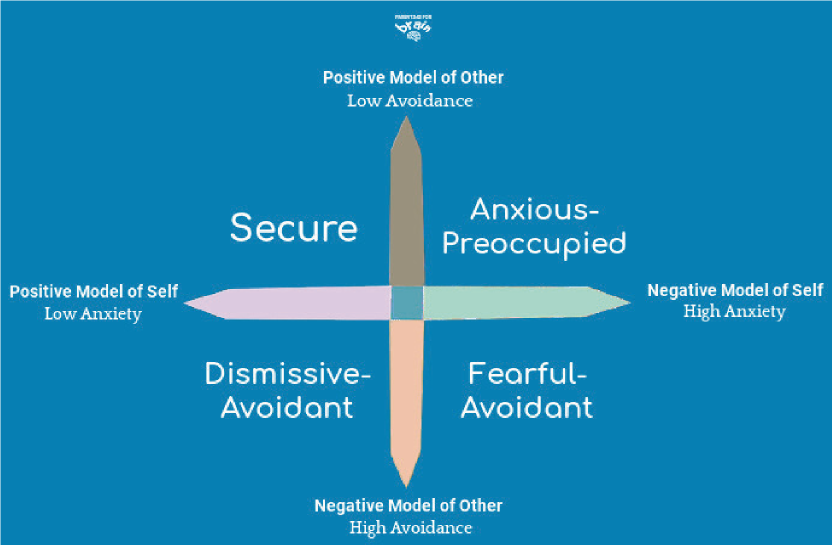
Figure: Ainsworth’s types of attachment
Source: https://www.parentingforbrain.com/attachment-theory/
5. Educational Implications of attachment theories
In educational settings, Bowlby’s and Ainsworth’s theories imply that students’ emotional security significantly influences their ability to learn, form relationships, and cope with challenges. Children with secure attachments tend to exhibit higher self-esteem, better social skills, and greater resilience, making them more engaged and motivated learners. Educators should therefore foster a supportive and trusting classroom environment where students feel safe, valued, and emotionally connected. Teachers can also play a compensatory role for students with insecure attachments by providing consistent care, encouragement, and positive reinforcement. Recognizing signs of attachment difficulties helps educators implement appropriate interventions, support social-emotional development, and collaborate with parents or specialists to meet students’ needs effectively.
Background Colour
Font Face
Font Kerning
Font Size
Image Visibility
Letter Spacing
Line Height
Link Highlight
Text Alignment
Text Colour