Section 2.4 Cognitive development theories
| Site: | UR - Elearning Platform |
| Course: | CD60143: Human Developmental Psychology |
| Book: | Section 2.4 Cognitive development theories |
| Printed by: | Guest user |
| Date: | Friday, 19 December 2025, 7:14 AM |
Description
Cognitive development theories explore how people think, learn, and understand the world as they grow. Thinkers like Piaget, Vygotsky, and Bruner emphasized that learning develops through active exploration, social interaction, and experience, showing that children actively build their own understanding.
1. Meaning and understanding
Cognitive development theory refers to the framework that explains how individuals acquire, organize, and use knowledge over time. Developed primarily by Jean Piaget, the theory emphasizes that children actively construct their understanding of the world through stages of increasingly complex thinking. According to this theory, cognitive development occurs in a series of sequential stages each characterized by different abilities in reasoning, problem-solving, and understanding concepts.
2. Basic components of Piaget’s cognitive theory
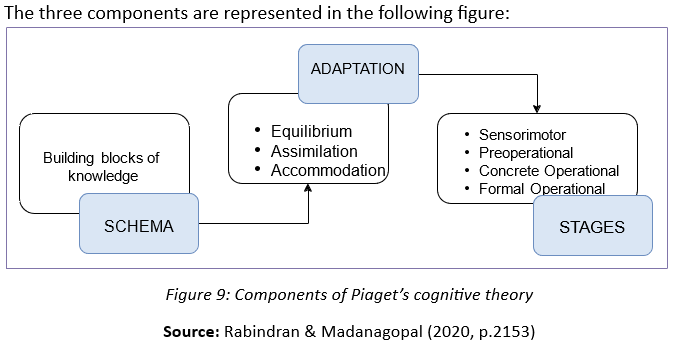
Piaget theory of cognitive development describes how humans gather and organise information and how these process changes developmentally. He believed that children are born with a very basic mental structure on which all subsequent learning and knowledge is based. For Piaget, the focus was on how mental structures and processes evolved to help individuals make meaning out of their experience and adapt to their changing environments. To understand this process of adaptation, he employed the concepts of schema, assimilation, accommodation and equilibration.
2.1. Schema
Schema is a building block of knowledge. For Piaget a schema (or the plural schemata) is referred to the cognitive structures by which an individual organizes his or her experience and environment (Rabindran & Madanagopal, 2020). For example, an infant upon encountering a dog for the first time will experience visually, auditory and olfactory input. These data, according to Piaget, will be linked in neural pathway, a schema that will eventually be used as a mental template to represent dog each time these stimuli are encountered.
2.2. Adaptation
Adaptation is an inborn tendency to adjust more attuned to environmental conditions. According to Piaget’s Cognitive theory, there are 3 components in adaptation namely Equilibration, Assimilation and Accommodation (Rabindran & Madanagopal, 2020).
• Equilibration is the process of balancing assimilation and accommodation to create stable understanding. It involves moving between states of cognitive balance (equilibrium) and imbalance (disequilibrium) as children encounter new experiences. Example: A child understands that a dog is a four legged animal (equilibrium). When they encounter a cat for the first time, they initially think it is a dog because it also has four legs (disequilibrium). After learning that cats are different from dogs, they adjust their understanding, achieving a new balance (equilibrium).
• Assimilation is the process of integrating new information into existing cognitive schemas without changing the schema. It involves applying what is already known to new situations. Example: A child who knows that birds can fly sees an airplane for the first time and refers to it as a “big bird.” They are assimilating this new experience into their existing schema of what a bird is, even though they are not yet aware that airplanes are different.
• Accommodation is the process of modifying existing cognitive schemas or creating new ones in response to new information that cannot fit into existing schemas. It involves changing one’s understanding to incorporate new experiences. Example: Continuing from the previous example, when the child learns that airplanes are not birds but machines that fly, they must accommodate their understanding. They create a new schema for “airplane” while adjusting their existing schema for “bird” to reflect that not all flying entities are birds (Rabindran & Madanagopal, 2020).
2.3. Representation of the three components
Background Colour
Font Face
Font Kerning
Font Size
Image Visibility
Letter Spacing
Line Height
Link Highlight
Text Alignment
Text Colour