Section 2.2 Psychoanalytic theory
| Site: | UR - Elearning Platform |
| Course: | CD60143: Human Developmental Psychology |
| Book: | Section 2.2 Psychoanalytic theory |
| Printed by: | Guest user |
| Date: | Friday, 19 December 2025, 7:17 AM |
Description
Psychoanalytic theory, developed by Sigmund Freud, explains how unconscious thoughts, feelings, and childhood experiences shape human behavior and personality. It emphasizes the influence of the mind’s unconscious processes, especially those formed during early development.
1. Freud three levels of consciousness
Every level of consciousness influences the formation of human conduct and cognition. Freud suggested that behaviour and personality stem from the continuous and unique interaction of opposing mental forces operating across three distinct levels of awareness: the conscious, preconscious, and unconscious. He asserted that each part of the mind plays a vital role in shaping human behaviour.
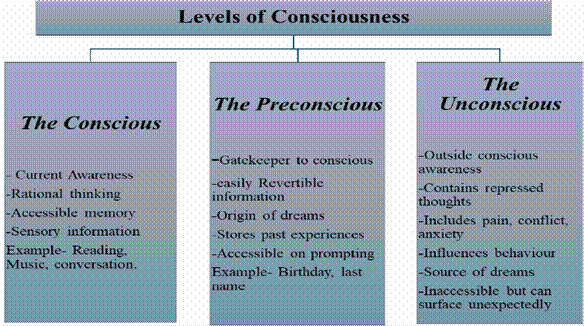
Figure 2: Flowchart of levels of consciousness
Source: (Singh et al., 2025)
2. The structure of personality
Sigmund Freud believes that human personality is intricate and has multiple components. Freud’s well known psychoanalytic theory suggests that personality is made up of three key elements: the id, the ego, and the superego. These factors combine to produce intricate human behaviours. Each component uniquely contributes to personality, and their interactions significantly influence the individual. Different aspects of personality emerge at distinct stages throughout an individual’s life. This provides an in depth examination of each essential component of personality, its respective functions, and its interactions.
• The id is present from birth and operates on the pleasure principle (seeks immediate gratification of desirers like hunger, sex and aggression. It is unconscious and irrational and is the source of instinctual drives.
• The ego develops in early childhood. It operates on the reality principle and mediates between the unrealistic id and the demands of the external world. It is a rational and conscious decision-maker. It balances the id and the superego to avoid internal conflict.
• The superego develops around age 5. It represents internalized moral standards from parents and society and acts as a moral conscience. In other words, it acts on moral principal. It can cause guilt and shame if rules are violated.
Table 1: Comparison of id, ego and superego
|
Component |
Description |
Operating principle |
Levels of consciousness |
Development stage |
Examples |
|
Id |
Source of all psychological energy; instinctive and primitive behaviours. |
Pleasure principle seeks immediate gratification. |
Entirely unconscious |
Present from birth |
A baby crying until fed, acting impulsively to satisfy desires without concern of consequences |
|
Ego |
Develops from the id; manages the id’s impulses in socially acceptable ways. |
Reality principle balances desires with real-world constraints |
Operates in conscious, preconscious, and unconscious levels. |
Develops soon after birth. |
Delaying hunger during a meeting until it’s appropriate to eat. |
|
Superego |
Internalized moral from parents and society; government judgement. |
Idealistic principle strives for perfection and morality. |
Operates in all levels of consciousness |
Begins forming around age of five. |
Feeling guilt for stealing; feeling virtuous for resisting temptation. |
Source: Singh et al., (2025, p.59)
3. The interaction of the Id, Ego, and Superego
When discussing the id, ego, and superego, it’s important to understand that these are not separate, rigid entities. Instead, they are dynamic components that continuously interact, influencing an individual’s overall personality and behaviour. Given the presence of conflicting forces, the id, ego, and superego often come into conflict. Freud introduced the concept of “ego strength” to describe the ego’s capacity to manage these opposing impulses. A person with strong ego strength can effectively navigate these internal conflicts, while someone with too much or too little ego strength may display inflexibility or disruptive behaviour (Singh et al., 2025).
Freud’s theory provides a framework for understanding how personalities are structured and how the different components function together. The id demands satisfaction, the superego imposes moral restrictions, and the ego must balance both with the reality of the environment.
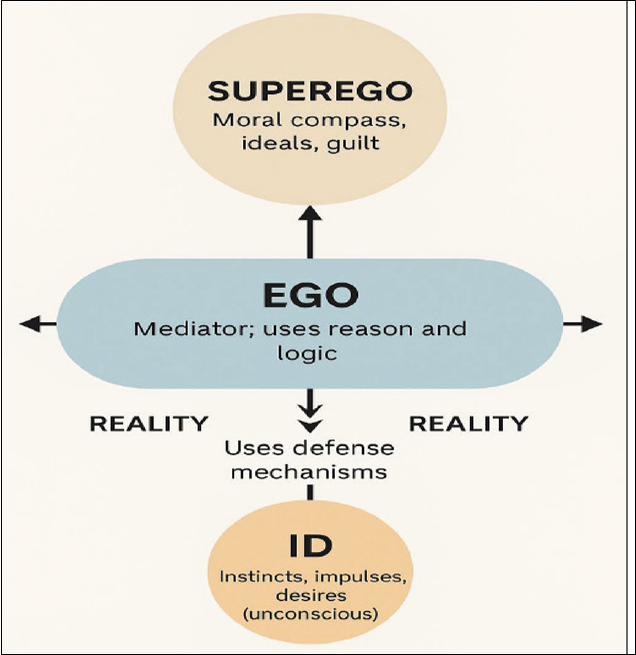
Figure 3: Interaction between id, ego and superego
Source: Singh et al., (2025, p.60)
Freud says that a healthy personality needs the id, ego, and superego to work together in harmony. Although the ego bears a significant burden, it need not operate in isolation. When the ego must balance the needs of primal urges, morals, and reality, anxiety helps. When people feel different kinds of anxiety, their defense mechanisms may kick in to protect their ego and ease their anxiety.
Defense mechanisms are unconscious psychological strategies used by individuals to protect themselves from anxiety, stress, or uncomfortable thoughts and feelings. Rooted in Freud’s psychoanalytic theory, these mechanisms help the ego manage conflicts between the id’s desires, the superego’s moral standards, and the demands of reality. Common defense mechanisms include regression, repression, sublimation, denial, projection, displacement, rationalization, intellectualization, and reaction formation. Understanding these mechanisms provides insight into how people cope with emotional challenges and maintain psychological balance in everyday life.
4. Psychosexual stages of development
According to Freud a person has two basic instincts: sex (life instinct) and aggression (death instinct). The libido is the available energy of sex and is vaguely translated as sexual pleasure. Sexual excitation arises from erogenous zones in the human body (Janetius, 2020). The change in the site of excitation underlies the moment from stage-to-stage development and the task is to achieve sex drive equilibrium.
Sigmund Freud’s psychosexual development can be defined as a harmonious interplay of the individual’s psychological and sexual capacities within an ordered and ethical value system. A person’s psychological growth is conditioned by the libido or the inner energy that is reflected in sexual growth. Also, our personality develops as we move through a series of psychosexual stages. There are five stages of development in all.
a. Oral Stage (0-18 months): Sexual gratification is obtained through oral activities. If a child is not sufficiently nourished, he or she tends fixate their pleasure-seeking energies on particular stage. Fixation may lead to gullibility, smoking, alcohol abuse, nail biting and/or excessive optimism/ pessimism.

Figure: Oral Stage
b. Anal Stage (18 months – 3 years): Sexual gratification is obtained through contraction and relaxation of the muscles that control elimination (Fixation may lead to anal-retentive or anal-expulsive traits). The child either becomes anal expulsive disorganised and often late for appointments, etc. or anal retentive highly controlled, rigid, and compulsively neat.

Figure: Anal Stage
c. Phallic Stage (3 - 6 years): Libidinal energy is shifted to the phallic regions (penis for boys and clitoris for girls). During this stage, boys experience the Oedipus complex while girls experience Electra complex.
• Oedipus complex: A conflict of the phallic stage in which the boy wishes to possess his mother sexually and perceives his father as a
rival.
• Electra complex: Like the Oedipus complex in that a young girl longs for her father and resents her mother.

Figure: Phallic stage
d. Latency Stage (6-12 years): The pressures of the Oedipus and Electra complexes cause children to repress their sexual urges and enter a period of latency where their urges remain unconscious.
e. Genital Stage (12-18 years): The mature stage of psychosexual development, characterised by the preferred expression of libido via intercourse with an adult of the opposite gender.

Figure: Genial stage
Table 2: Freud’s psychosexual stages of development
|
Stage |
Age |
Pleasure source |
Conflict/difference |
|
Oral Stage |
Birth to 18 months |
Mouth: sucking, biting, swallowing |
Weaning away from mother’s breast |
|
Anal Stage |
18 months to 3 |
Anus: defecating or retaining feces |
Toilet training |
|
Phallic Stage |
3 to 6 |
Genitals |
Oedipus & Electra Complex |
|
Latency Stage |
6 to 11 |
|
|
|
Genital Stage |
11 to 18 |
Physical sexual changes Reawakening of repressed needs Direct sexual feeling towards others |
Social rules |
Source: Adapted from Janetius, (2020, p.5)
5. Educational implications of psychoanalytic theory
The educational implications of psychoanalytic theory highlight the importance of understanding learners’ emotional development, unconscious motivations and early experiences in shaping behaviour and learning. Here are key implications:
• Understanding emotional needs: Teachers must be aware that students may have unconscious emotional conflicts affecting their learning and behaviour. Creating a supportive and safe classroom helps students feel secure and open to learning.
• Importance of early experiences: The theory emphasizes that early experiences significantly impact later development. Early education should provide emotionally positive experiences to build a strong foundation.
• Role of the teacher as a support figure: Teacher can be seen as authority or parental figures. Building trust and positive relationships helps students feel emotionally supported, especially those with difficult backgrounds.
• Addressing behavioural problems: Misbehaviour may be a result of unresolved inner conflicts or unmet emotional needs rather than disobedience. Teachers should approach discipline with empathy and understanding.
• Individual differences in learning: Since student has a unique psychological background, teachers should consider individual emotional and developmental differences rather than applying one size fits all methods.
• Encouraging self-reflection: Encouraging students to reflect on their feelings, thoughts, and behaviours can promote emotional intelligence and personal growth.
• Therapeutic interventions in schools: In some cases, psychoanalytic ideas support the use of school counselors or therapeutic techniques to help students cope with deep seated issues that hinder learning.
Background Colour
Font Face
Font Kerning
Font Size
Image Visibility
Letter Spacing
Line Height
Link Highlight
Text Alignment
Text Colour